
The Process
Principal-Led Residential Architecture on Cape Cod and the Islands
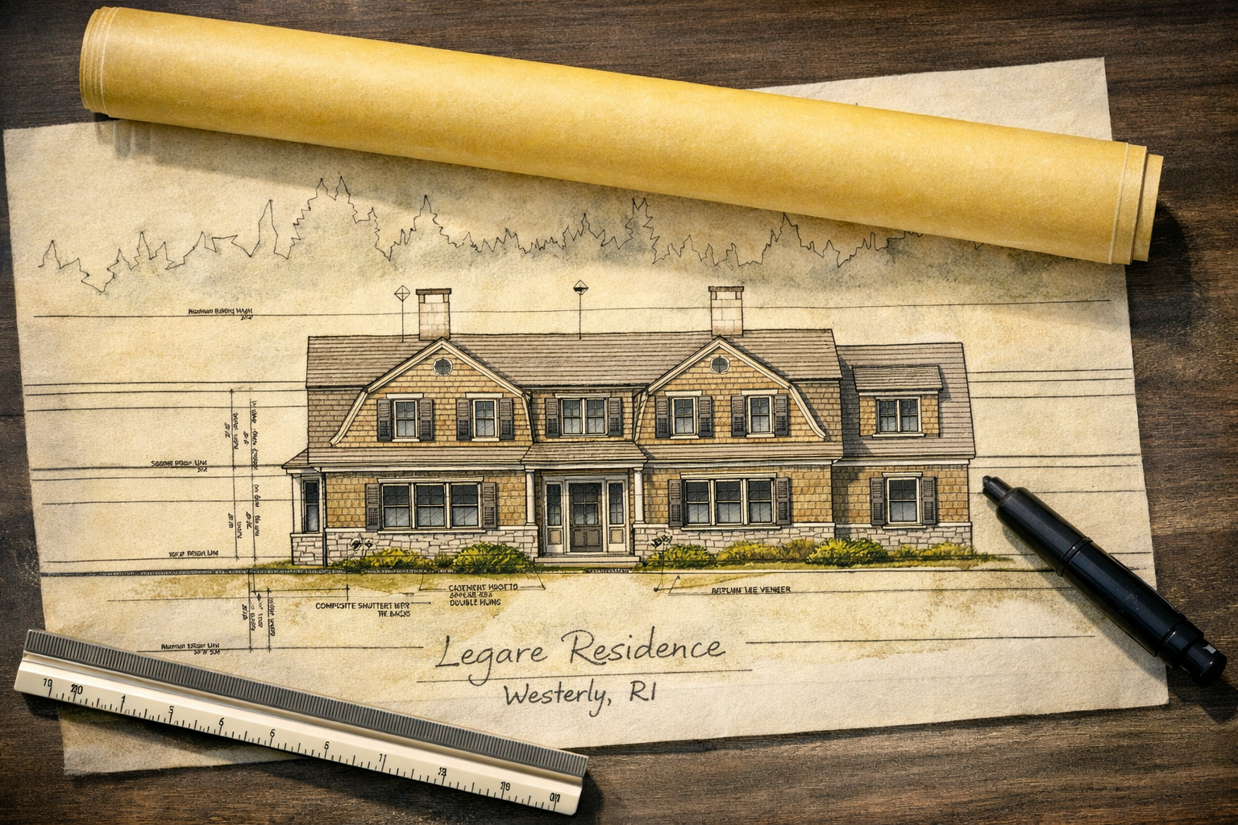
You have been thinking about this project for longer than you've been talking about it. The land has been in the picture for years, maybe longer. You've walked the site in different seasons. You have a sense of what you want the house to feel like, even if you can't fully articulate the architecture yet.
What you're protecting is not just a construction budget. It's the one chance to get this right on this piece of land. A decision made at the wrong moment, by the wrong person, with incomplete information about what the site will support — that's the thing that doesn't get corrected. You build around it for fifty years.
This practice is organized around that reality. Every phase exists to make the right decision at the right time, with the right person in the room. That person is always me. The apprentices in this atelier are present to assist and to learn — they support the work, they do not lead it.
The margin for error on this land is generational. That is the standard this practice works to.
Why We Build This Way
On permanence
A home designed with permanence in mind outlasts every trend, every market cycle, and every decade of second-guessing. The proportions hold. The materials weather rather than fail. The relationship between the building and the land deepens with time rather than dating itself. This is not a stylistic preference. It is a different design philosophy entirely — one that asks what the home will look like in fifty years before it asks what it will look like on Instagram.
On place
Cape Cod, the Islands, and coastal Rhode Island are not generic luxury markets. They are specific places with specific building traditions, regulatory environments, and community character. A home that belongs in Osterville does not belong in Edgartown. A roofline that works on the bluff at Watch Hill does not work on a back lane in Nantucket. Regional fluency is the precondition for everything else.
On budget
Budget is not what gets discussed at the end of the design phase. It is what shapes every decision from the first conversation. We establish a realistic construction cost target at the outset and design to it deliberately — making material and scope decisions with budget consequences in mind from the first session, not discovering them in the contractor's bid.
On communication
You have my direct number and you can reach me. More importantly: I reach you. When a decision needs to be made, I call — with the relevant information, a clear recommendation, and enough context to make the choice confidently. You are not managing this project. I am. Your role is to make the decisions that are yours to make. My role is to make sure you are never making them without the right information.
On accountability
This practice has no construction arm. The architect's interests and the client's interests are structurally identical: to produce a building that matches the design, on budget, without improvisation in the field. When the same firm designs and builds, that alignment is not guaranteed — it requires intention to maintain. Here, it requires nothing. It is the structure.
Within the atelier, drawing sets are produced by apprentices under my direct review. This is a structural advantage. The work is executed by people who have been taught by the architect responsible for the design — and reviewed by him at every stage. The result is documentation that a contractor can build from without phone calls, because every line on the page has been examined by the person who drew the design behind it.
On Restraint
A 9,800 SF house and a 2,800 SF cottage have different programs but the same design problem. They both need to look like themselves rather than like a smaller or larger version of something else. Large houses are particularly vulnerable here. The instinct is to fill the available size with architectural moves — more gables, more dormers, more stone, more trim. The result is a building that reads as a hotel or a wedding venue rather than a home. The work is in restraint. Place the architectural emphasis in one or two specific moves. Let the rest of the building be quiet. The proportions, the materials, and the site relationship carry the design — not flourish.
On the specific
Every project this practice takes on is for a specific family on a specific piece of land. The custom moments that make a house feel inhabited — the bunk loft that fits this family's grandchildren, the porthole window over the stair, the named shower in the pool house — are not transferable to any other commission. They are the project.
A house that could belong to anyone is, eventually, owned by no one. The detailing has to be specific or it doesn't matter.
The Six Phases
A well-managed custom home project moves through six distinct phases. Understanding them before you begin puts you in a fundamentally different position as a client — able to make decisions at the right time rather than reacting to them.
Phase 01 — Feasibility
The threshold phase. Can this project be built, on this site, within this budget? Site analysis, regulatory research, preliminary massing, and a realistic budget assessment. The output is not a design. It is clarity — about what is possible, what the constraints are, and what the path forward looks like.
Typical duration: 4–6 weeks
Phase 02 — Schematic Design
The architectural idea is established. Organizational logic. The relationship of the building to the site. The character of the architecture. Drawings at this phase are intentionally loose — they communicate ideas, not dimensions. This is where the most important decisions are made and where client engagement matters most.
Typical duration: 6–10 weeks
Phase 03 — Design Development
The schematic idea is resolved into a fully coordinated design. Room dimensions confirmed. Structural systems integrated. Mechanical systems planned. Material selections made. Interior architecture detailed. Drawings become precise. Interior selections — millwork profiles, tile, hardware — happen here, not after construction has begun.
Typical duration: 8–12 weeks
Phase 04 — Construction Documents
The design is translated into the technical language of building. Architectural plans, elevations, sections, and details; structural engineering drawings; mechanical, electrical, and plumbing drawings; full specifications. This is the most consequential phase for what will actually get built. Well-documented projects have fewer change orders, fewer conflicts, and fewer surprises.
Typical duration: 10–16 weeks
Phase 05 — Permitting & Approvals
Building department, Conservation Commission, Board of Health, Historic District Commission, DEP — whatever applies. I prepare every filing, attend every hearing, and respond to every commission question. This is not a phase to outsource; the regulatory environment in coastal Massachusetts requires fluency that takes years to build.
Typical duration: 8–24 weeks
Phase 06 — Construction Administration
The architect's role during construction. Shop drawing and submittal review. Site visits to observe progress and verify conformance. RFIs answered. Field decisions made. This phase is often underscoped by clients who assume the building permit means the architect's work is done. It is not — and the quality of construction administration has a direct, visible effect on the finished building.
Typical duration: 14–22 months, varies by project scope
Total: concept to occupancy is typically 3–4 years. This is not unusual for a custom home of any ambition in this region. Quality work, done carefully, takes time.
On the Practice of Practice
One more thing worth saying. Occasionally, a student from my architecture program at NEIT will observe a project in progress. Not to assist. Not to manage communication or handle drawings. To watch. To learn what it looks like when a commission is carried with full attention from the first conversation to the final walk through.
Architecture is transmitted through proximity. It always has been. The client experience is unchanged. The principal is always in the room. But the work, quietly, becomes part of something larger than one building.